
So, there I was, in Leeds on a November evening with the temperature hovering around freezing, dressed up like one of Ernest Shackleton’s crew members and heading to Howard Assembly Room to see a musical ensemble whose instruments were made out of ice. The concept of the Ice Quartet was inspired by the sounds of nature. As Mr Isungset is from Hol, a small town situated on an island in the north of Norway – you can’t miss it as it is next door to Hov – the sea, snow and ice play an important role in the ecology of the place.
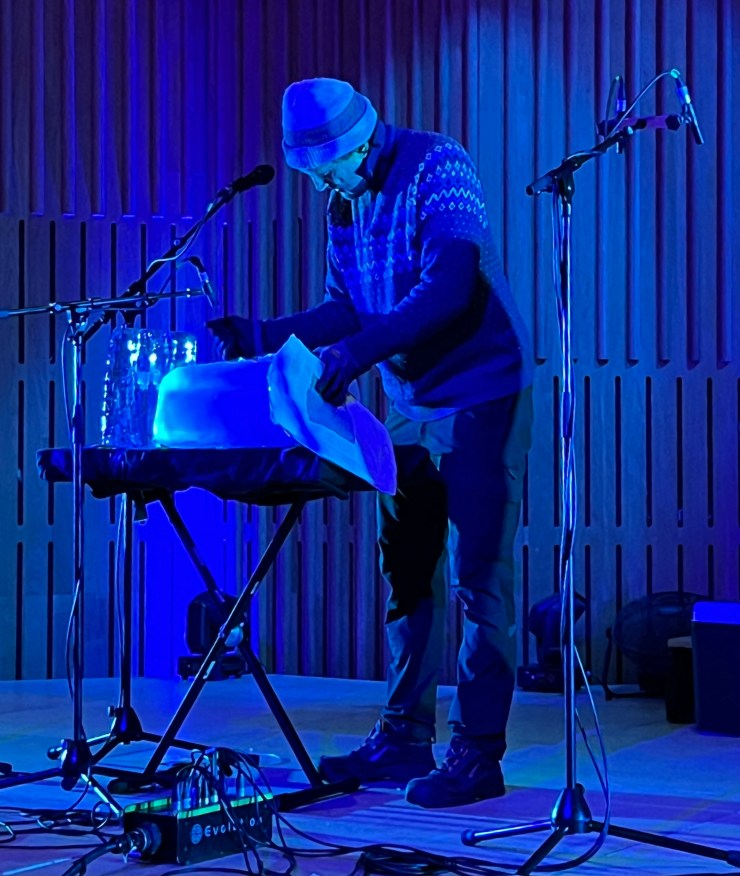
Mathias Grønsdal creating the ice mortar ready for the maestro’s ice pestles
His more mainstream instruments are percussion, a few ice versions of which were in evidence during the show, but which sounded totally different from tom tom and hi-hat, and were played by hand rather than ice sticks, which would not have lasted very long. There were others which are unique to this line-up, one of which was a tall, cylindrical stand with a dish-like top containing crushed ice, ‘played’ with a couple of glass pestles to rhythmically crush the ice even finer. Also in evidence were ice tubular bells, made from rectangular sheets of ice which sounded like wind chimes when disturbed. Another adaptation was the iceophone. It resembled a thick lectern with a flat top which bore more rectangular ice keys, reminiscent of a large dulcimer, which it sounded uncannily like when struck with a gloved hand. Ice horns, which didn’t have mouthpieces or reeds, were either blown down to recreate the sound of wind, or the lips were pursed before being blown through, to mimic the call of a whale. Amalie Holt Klieve, who wrote a couple of the songs, also played percussion and sang. Towards the end, she filled a contraption with water, which was amplified as it ran through, making me wonder whether it had been a great idea to have had a pre-show pint at the Templar.

The other two musicians, who didn’t have the luxury of being able to wear gloves, were Toivo Fjose on ice bass and Julie Rosketh, ice harp. For obvious reasons, the fingerboard of the double bass and the bow, used on a couple of occasions, were made of more conventional material. I couldn’t see the strings in enough detail from where I was seated, but those on the ice harp seemed to be of a synthetic material, presumably to withstand the cold, and the dampness as the ice gradually melted. In addition to plucking the harp strings, Ms Rosketh used a small hand held fan to make the strings vibrate and produce a unique sound.
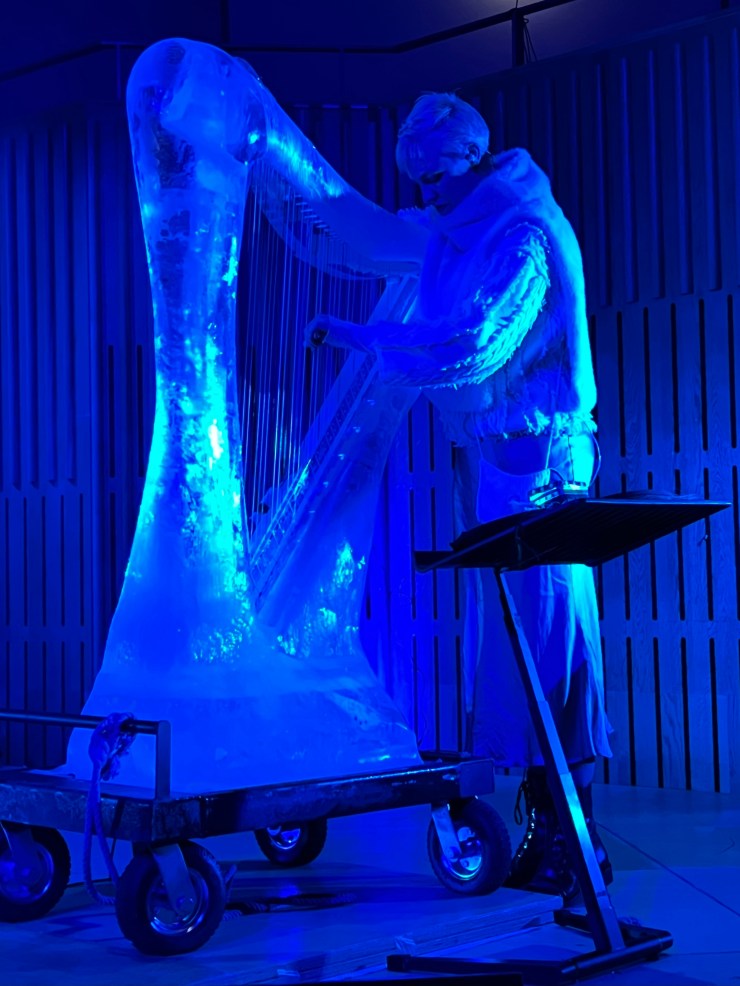
Julie Rosketh looking like an ice angel tuning her ice harp.
Because of the transition from solid to liquid, when not in use, the instruments had to be covered in an insulated material to slow down the process, a bit of a feat when it came to the ice harp! This task was carried out by Mathias Grønsdal, the sound designer/ice roadie, as was the removal of the tubular bells, bars on the iceophone and a couple of ice sheets on strings which Ms Klieve struck together in one piece, so that they too could be kept at a suitable temperature until brought out again for their next contribution to the concert.
The music itself was mainly of an ambient nature, pardon the pun, except for the occasional animal call. It was a very peaceful and relaxing experience, helped by the subdued purple and blue lighting reminiscent of the extreme north of Europe in the long winter months. It reminded me of Iceland in February anyway.
One of the tunes was inspired by the feeling experienced by Mr Isungset when standing in a fissure between two large vertical rock faces, many metres high. It brought home to him just how small we are in the scheme of things.
The feeling of calmness was reinforced by the timbre of Mr Isungset’s voice in his addresses to the audience during the gaps between pieces. He was quietly spoken and deliberated over every word, his English was very good, so I don’t think it was out of trepidation. He would make a great hypnotherapist, as, had I been lying on a couch in a calm consulting room, I am sure I would have drifted off into another place, as I did here I suppose.
His words at the end summed up the concert superbly, in both its delivery and ethos. He said that, as we would expect, there were cds and other items for sale on the way out, but that didn’t matter and the best thing we could do was keep the music in our hearts and take the memory of the performance home with us.
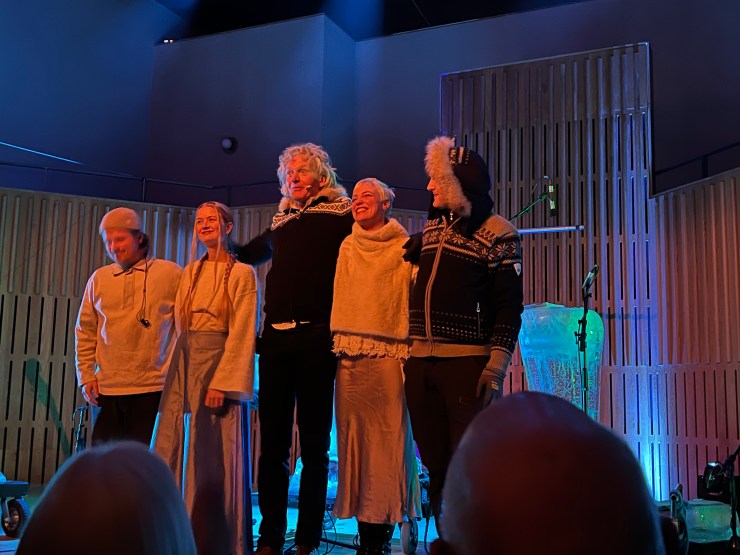
Left to right: Toivo Fjose, Amalie Holt Klieve, Terje Isungset, Julie Rosketh and Mathias Grønsdal.
Sadly, due to the gradual thawing of the instruments, the concert only lasted an hour, the bonus was that we were not subjected to the charade of a contrived, surprise encore. Had we been I suppose they could aways have finished with the Ramsey Lewis classic, Wade In The Water.
Should you get a chance to see them, I heartily recommend that you take it.
For more about Terje Isungset and the Ice Quartet, please go to https://www.terjeisungset.no/ice-music-pioneer where there is also a brilliant trailer. There is a superb video on YouTube of a mash up of tunes played at a concert at Bristol St George’s Hall in 2023, but I get an error message when trying to download the link. It is worth searching for.
A list of his coming concerts is at https://www.terjeisungset.no/tours-concerts
To see what is coming to Howard Assembly Room see https://www.operanorth.co.uk/event-tag/har/
Photographs by Stan Graham.

